_edited_edited.jpg)
Renewable Energy Promises Egypt a Brighter Future
By: Marina Mamdouh
The renewable resources of energy contribute to Egypt’s sustainable development as a viable solution for the electricity crisis and an accelerator for economic development.
Egypt has started to move towards achieving sustainable development and realizing Egypt’s Vision 2030. Officials have already set a unified plan for the expected progress in all fields under the title “Egypt’s Strategy for Egypt’s Vision 2030”.
Egypt’s Vision 2030 aims to achieve a competitive, diverse and flexible economy and (to) increase employment rates as well as providing decent work opportunities. Moreover, the energy sector is one of the important pillars of the economic dimension in the strategy, as it seeks to achieve Sustainable Development Goal No. 8, i.e. decent work and economic growth.
The increase in population causes an increase in energy needs and demand. There is a dialectical relationship between energy production and consumption, and sustainable development. Non- renewable energy prevents the progress of sustainable development, while renewable energy is one of the helping factors to achieve this goal. Therefore, Egypt has launched several huge projects to support the use of different renewable resources of energy.
Hydropower
Besides the high dam, with a production capacity of 2100MW, there are other hydroelectric stations, their production capacity is supposed to reach 2400MW. (It is) These stations are under construction and are expected to start operation by 2022.
Wind Power
Taking advantage of the wind velocity, the government has built several wind farms to produce electricity. Zaafarana Wind Farm, which produces 540MW, is one example. Moreover, 5 other new wind farms, of a total capacity of 2900MW, are expected to be built at the Gulf of Suez.
Solar Energy
The government has founded the largest and most important infrastructure project known as Benban Solar Park, in Aswan governorate. In 2021, President Abdel Fatah El Sisi inaugurated the first phase of the project, with a production capacity of 50MW. The whole complex will be completed by 2022 with a total production capacity of 1456MW.
Nuclear Energy
Egypt has successfully ventured into the production of nuclear power and eventually built a nuclear energy station in El Dabaa. Four Russian units have been installed. The units use a pressurized water reactors to produce electricity.
Renewable energy is an essential factor in turning the production cogwheels and providing decent job opportunities for the (young) youth so that stability and growth are achieved. Local and national companies have a fair share in these projects as they represent about 20% of the working force in each unit which is a good indicator of the increase in the Egyptian youth employment rate. In general, it can be said that investment in the energy sectors stimulates sustainable economic development and contributes to the realization of the UN SDG 8.

Funding youth… For a Better Future
by: Salma Hany
Egypt is investing millions in funding startups created by young entrepreneurs to achieve economic development within the framework of Egypt’s Vision 2030.
The economic influence and job opportunities that startups provide drew the attention of the world to the importance of small businesses for years now.
According to The Ministry of Planning there are 9.7 million workers in the small businesses sector, with a production value of 1.237 trillion EGP.
The State Organs, led by Mr. President Abdel-Fattah Al-Sisi, several ministries, as well as stakeholders in collaboration with the state banks and several NGOs have launched many opportunities to fund the small businesses of Egyptian youth that appeared on the scene especially after COVID-19 crisis.
The financial funding for these businesses comes from two sources. Firstly, banks, governmental initiatives, and ministries, which invest more than 200 billion EGP in startups. These financers include the state banks such as Banque Misr and Alex Bank, in addition to government agencies such as Micro, Small and Medium Enterprise Development Agency – MSME. All these loans are at low interest rates that reach 5%.
The governmental initiatives are not only about financially funding youth, but they also provide internships and information about the financial funding agencies. Nile Pioneers is an initiative that puts youth on the starting point by providing information regarding their projects, and it helps with establishing these projects. Another initiative called Work from Home provides youth with internships and online job opportunities.
The second source of funding includes NGOs that invest a maximum amount of 50,000 EGP in startups at zero interest rate such as Life Makers program.
Egypt is investing in the next generation and bets on the youth force to develop the Egyptian economy, decrease imports, and increase exports. Startups in Egypt have not reached high exporting rates in the few past years, but it is a very important term in Egypt’s Vision 2030 aims to increase these rates to new levels.
Rise Like a Phoenix
By: Salma Mohsen
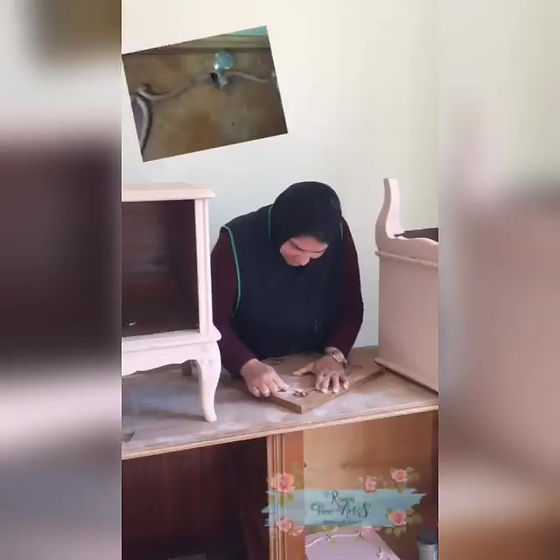
Recently, women have started trying to integrate into society and face difficulties through the establishment of small enterprises, including small projects for handicrafts. We interviewed Mrs. Marwa Masood, who is the founder of the Ruya project for decoupage and furniture renovation, to get to know her experience in the field.
Who is Professor Marwa Masood?
I am Marwa Masood, 41 I graduated from the Faculty of Art Education, Helwan University.
What motivated you to create your project Ru'ya?
Actually, there were several reasons that made me think of creating Ru'ya. First, I was pregnant with my daughter, but when she was born, she had some health issues, and sorrowfully she passed away. In Mourning, my husband also passed away two months later. I had to face many challenges, at that time. The pension benefits alone were not enough. I thought about using my talent and my love to restore furniture, to urn some extra pounds. What encouraged me is that my father had a carpentry workshop and knowing that I had to face difficulties made me think of creating Ru'ya.
With how much capital did you start the project, and did you need a start-up?
My friend and I started a partnership with a capital of 10 thousand pounds, each of us paid 5 thousand EGP. For the project to succeed, we did not take the profits instead, we use it all to buy new materials
Why did you choose the name of Ru'ya for the project?
I chose the name Ru'ya, because it was the name of the daughter I lost.
What difficulties have you faced while establishing your project?
They were all external difficulties, first was that the market is not controlled, so the price of raw materials is not stable and some monopolize certain commodities. Secondly, we faced some problems because we are women, as the owner of the building) where the workshop is located is trying to take it from me. Thirdly, dishonest competition, some competitors replicate your ideas with low-quality materials and cheaper prices, which encourages the customer to buy the cheaper product. Also, appearing in the media requires a lot of effort, especially the private media.
Have you participated in any exhibitions?
Yes, I participated in many exhibitions, including private exhibitions that are held in clubs and malls, but it was costly, as we spent a lot of money to display our products. We also shared in some exhibitions organized by the public sector such as Turathna (Our Heritage) (http://turathna.eg/en) and Darian (Our Homes)
(https://www.facebook.com/Diarna.moss/), which were not expensive and helped us gain many experiences in the field.
Tell me about the most remarkable products by Ru'ya?
Some products were important to the project, such as the chair that we made for Mrs. Esaad Yunus, who had a great impact on our success journey.
Have you participated in charitable work for People of Determination?
Yes, I contributed to the education of People of Determination in decoupage and displayed their work in the children's exhibition.
Finally, can you share with us your dream for the future?
My dream is global reach.
Thank you Marwa for this inspiring talk, hopefully, young women will follow your lead and start thinking of unconventional ways to start their careers and overcome any challenges.
You can find more details on Ru’ya’s Facebook page:
Good Idea –v- Successful Idea
By: Mariam Mabrouk
Years ago, the world never imagined that there would be a network to connect people together without having to meet live. The Internet is not only connecting people to strengthen their social ties, but also to develop their businesses. Today it just takes a click to start a new business. However, we need some more clicks to switch on our innovation. The first step we need is to search the market.
Is this product permissible?
Is this product essential or just a luxury?
Is this product worth the effort?
Let's say that we found out that our product is achievable, worthwhile, and needed. We should start looking for a marketing plan, and ways to fund the business. Although 35% of small business managers feel that their business is too small for a website, having a website can significantly boost your outreach and increase your profits is not a must. It's achievable, essential, and funded? Wonderful! Let's create your webpage. Choose the logo, make the products and start clicking. Starting up is not as difficult as most people imagine; it can all start one click at a time.

PWDs Inclusion in the Entrepreneurial Wave
By: Shahd Sameh
Disability is natural. We must stop believing that disabilities keep a person from doing something. Because that’s not true. When you focus on someone’s disability you’ll overlook their abilities, beauty, and uniqueness. PWDs are not the problem; the problem is the way society looks at them. PWDs have abilities but in different ways. They need different ways to deal with them and a specialized person to unleash their abilities, skills, and talents.
In Egypt, PWDs face many challenges concerning their employment, as most company owners don’t make sense of their qualifications, and because employment requirements mainly depend on academic qualifications rather than skills. Consequently, there aren’t enough job opportunities for them. The number of PWDs in Egypt is estimated at about 11 to 14 million disabled persons which is about 12% of the total population, and they all need chances like other citizens of Egypt. In 2018, PWDs employment rates dropped significantly, which caused them a big loss. As for their current situation in Egypt, the government is more concerned than ever about their future and business. It encourages the establishment of organizations, projects, and activities to serve PWDs. The government also provides educational services, so it built many specialized schools, with teachers specialized in dealing with different forms of disability. Governmental and non-governmental organizations provide health services for PWDs. They build many rehabilitation centers for the mother and child to improve their awareness toward the disabilities, and ways to deal with them. Unfortunately, they haven’t yet succeeded to reach enough families who are going through this experience.
In The United Nations (UN) 2030 agenda on sustainable development goals, they tend to reach more people and let them have better chances for employment. Startups are among the most successful, and effective tools for economic development in Egypt nowadays. Everyone can use their own ability and talent as a source of earning money and living a better life.
Therefore, the inclusion of PWDs in the entrepreneurial wave will be such a perfect solution for this crisis. PWDs could make use of their own talents in their own way, they can participate in many jobs, such as marketing, freelancing, photocopying, and handcrafts. Everyone has his own abilities, talents, skills, and way of thinking which only need to be understood and appreciated by others to grow and improve.
Female entrepreneurs rock the business
By: Mai Hesham
Egyptian women are able to climb the walls of entrepreneurship and prove their capabilities and potential. We review the profiles of 5 Egyptian female entrepreneurs paving the way for a major transformation in the world of economics.
Yasmin Helal is the founder and CEO of Educate Me foundation since 2010. She is also a player on the national basketball team.
Educate Me is a non-profit organization. Its goal is to change the education system and concept in Egypt, and this is through an advanced educational paradigm based on skills, as it also focuses on the student or the learner in general. Its goal is to market and promote the concept of responsibility, and it encourages learners to be more independent and creative.
Educate Me Foundation provides training and development programs for everyone who wants to learn, whether teachers or students. It has also provided more than 700 free scholarships for children to pursue their education.
Rasha Abu Al-Saud is the founder of the Women Entrepreneurs Network in Egypt. Abu Al-Saud is an entrepreneur who pursues her passion and dream, by helping women become entrepreneurs. Abu Al-Saud overcame many obstacles to be a writer, entrepreneur, and mother of two children.
Abu Al-Saud launched the Women Entrepreneurs Network in Egypt in 2015. It is a platform that monitors entrepreneurial activists, funding campaigns, and events related to women's projects.
The most prominent challenge that Abu Al-Saud has faced, is the low quality of education in some institutions in Egypt. Therefore, she set her mind on improving this situation.
Radwa Rustum is the founder of Hand Over. She is a civil engineer who passionately strives to achieve sustainable development goals. Her passion drove her to solve the problem of the housing shortage in poor communities in Egypt, so she built new homes that are environmentally friendly.
Rustum won a grant from The DO School in Hamburg, Germany, thanks to her idea of providing living housing and a decent life for residents of underprivileged neighborhoods in Egypt. In addition, Hand Over provided extensive training opportunities for civil engineering and architecture students to help them design and implement sustainable housing using ground impact technology.
These outstanding models, prove to us that what is more difficult than being an entrepreneur is to be a female entrepreneur, especially in our society. However, many Egyptian women have struggled to reach their goals and dreams and are still struggling to break the reality imposed on them by the Arab community and create a new reality that fits their abilities and their potential.
.png)
Good Governance & Egypt’s vision 2030
By: Eman Ramadan
Egyptian government effectively contributes to the economic sustainable development of Egypt’s vision 2030.
Egypt’s vision 2030 aims to achieve comprehensive and sustainable economic development through enhancing the Egyptian government policies to realize the objective of the 2030 national agenda of government transparency and efficiency.
The 4th pillar in Egypt’s vision 2030 development strategy focuses on concentrating the efforts of the government to promote transparency, accountability, and efficiency of public institutions and aiming to eliminate corruption in civil services. The Egyptian government endeavors to boost the investment and economic growth rate, enhance economic resilience, productivity and competitiveness, reduce unemployment rates, and provide decent job opportunities for the citizens.
To accomplish these objectives the Egypt Economic Governance for Development Project is supporting the Egyptian government reformations to enhance its capabilities to put an end to institutional corruption. The private and public sectors collaborate to execute these activities.
There were some major steps taken in this direction as follows:
-
Encouraging major reforms in the public institutions to promote public and civil services and improve administrative effectiveness.
-
Enhancing the Egyptian civil services through implementing transparency and integrity standards in the workplace.
-
Developing the electronic services for Egyptian citizens and investors.
By 2030, Egypt is expected to be the sixth-largest economy in the world through achieving an efficient administrative government.
